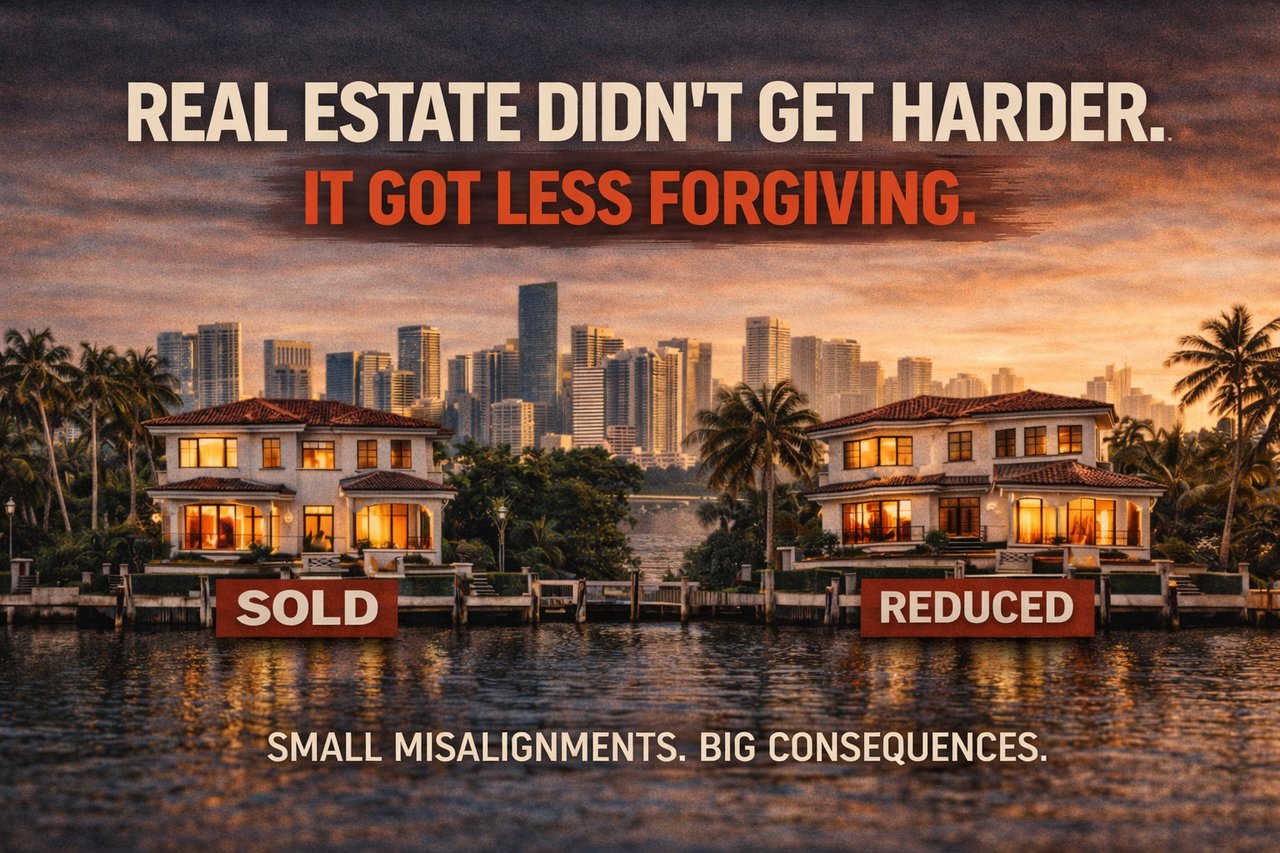
Real estate didn’t get harder. It got less forgiving. If this market feels difficult, it’s not just the market: It’s the shift between how deals used to work—
and how they work now.
For years, you could be slightly off—on price, timing, execution—and still win. Not because the deal was perfect. Because the market absorbed the imperfection. That’s what changed.
Now, it doesn’t correct mistakes. It reveals them.
Why It Feels Like “Harder”
For a long time, real estate rewarded movement. Not precision.
-Cheap debt made mistakes manageable.
-Liquidity made exits possible.
-Appreciation filled in the gaps.
So the dominant behavior became: Act first. Adjust later.
And in that environment, it worked. The challenge now is that behavior didn’t change—but the conditions did.
Where It Actually Breaks
This isn’t just a slowdown. It’s a narrowing of margin. Sellers don’t need to move. Buyers can’t stretch the way they used to. So the space between them doesn’t close. It holds.
And in that kind of market:
- You can’t buy low enough
- You can’t sell high enough
- And small misses don’t get corrected
There’s less room to recover from being slightly off. You don’t negotiate your way out of a bad position anymore.
You sit in it.
The Real Shift
Activity used to cover inefficiency. Now, it exposes it. Doing more deals doesn’t protect you if the assumptions behind them aren’t tight.
You start to see patterns:
- A deal that looked fine doesn’t exit
- Pricing that felt reasonable doesn’t attract demand
- Timing that used to work no longer lines up
The difference is subtle—but expensive. If a deal depends on everything going right, there’s less margin for that now.
How It Shows Up in Miami: Three themes-
This becomes clear when you look at how similar properties behave differently.
Brickell:
Two comparable units. Same price range.
One moves. One doesn’t.
That gap is rarely random.
Coral Gables (specifically: $1–3M)
Homes are trading. But only when three things line up:
- Price
- Product
- Expectations
Miss one—even slightly—and activity slows more than expected.
Coconut Grove (Where Intentions Don't Always Translate)
This is where the disconnect shows up differently.
- You renovate.
- You improve.
- You price with a margin in mind.
The intention here is to create value. But the buyer evaluates it differently:
-They’re not just asking “is this better?”
-They’re asking “is this what I would have done?”
And if the answer is no, they don’t pay for it the way you expect. It’s not that the improvement was wrong.
It’s that alignment wasn’t there.
Miami Beach:
Here, timing becomes the pressure point. Some deals don’t fall apart on price—they fall apart on when the exit needs to happen.
If the outcome depends heavily on timing,
the margin for error is thinner than it used to be.
The Shift Most People Miss
What looks like a deal problem is often a precision problem. The instinct is still to look for opportunity. But the market is increasingly filtering for accuracy.
That’s where friction shows up:
- Assumptions get stretched
- Adjustments don’t land the same way
- Movement doesn’t fix the position
And the feedback loop is slower than expected. It doesn’t always show immediately—it shows when the market doesn’t respond.
How to Tell If You’re Being Filtered by This Market
Before assuming the market is the problem, pressure-test your position.
Answer yes or no:
- Did you underwrite this deal assuming you could adjust later if needed?
- If demand slows, is your only move to reduce price?
- Are you relying on a specific timing window to make the deal work?
- Would this deal still make sense if you had to hold longer than expected?
- Did you base your pricing on comps that haven’t actually traded recently?
- Are you assuming a buyer will value your improvements the same way you do?
- If this doesn’t move in 30–60 days, do you have a clear second strategy?
- Are you more confident in the opportunity than in the precision of your numbers?
What Your Answers Suggest
0–2 Yes
You’re likely aligned with how this market is working.
The margin is tighter—but you’re accounting for it.
3–5 Yes
There’s exposure.
The deal might work—but it’s carrying risk that may not show up immediately.
6+ Yes
You’re depending on the market to do work it’s no longer doing.
What To Do With That:
If you’re in that middle or top range, the question isn’t: “Is this a good deal?”
It’s:
“Where is this exposed—and how early can I fix it?”
Because in this market:
- Timing doesn’t save you
- Adjustment doesn’t save you
- Only precision does
Bottom Line:
This isn’t a bad market. It’s a more exact one. And exact markets don’t respond to “close enough”
the way previous ones did. That doesn’t mean deals aren’t happening. It means they’re happening with less margin for error.
And when something is slightly off—It doesn’t correct itself. It stays there until it’s addressed directly.
Final Note
Most people don’t lose in this market because they made a bad decision.
They lose because they didn’t identify where they were exposed—early enough to fix it.
If You Want to Go Deeper
If you went through that and realized there are a few areas where the deal feels… less clear than it should—that’s usually where the risk is. Most of the time, it’s not obvious when you’re inside the deal.
It becomes obvious when you step outside of it. If you want a second set of eyes on how it’s structured—where it’s tight, where it’s exposed—
I’m happy to walk through it with you.
No pressure to move forward.
Just clarity on what you’re actually sitting on.