Most people don’t read their contracts. That’s not the problem. The problem is that they sign them anyway.
If you’re in the middle of a deal—or about to be—this matters more than you think. What feels like a formality is, in reality, the moment where risk gets assigned. And most people have no idea where it’s landing.
Why this feels normal
Contracts are presented as routine.
They’re standardized, widely used, and structurally familiar. There is almost always someone guiding you through them, and the process itself has been designed to feel straightforward. What used to require time and physical presence now happens digitally—no printing, no flipping through pages, no natural pause.
You open the document, move through a series of signature boxes, and complete the process in minutes.
It feels efficient. It feels clean. It feels like progress.
There’s one more assumption that makes this worse
You’ll often hear some version of the same reassurance:
“It’s a standard contract.”
“It’s boilerplate.”
“Don’t worry about that part.”
And technically, that’s true.
Most real estate contracts are standardized. Agents don’t draft them; they complete them. But that doesn’t make them harmless. “Standard” does not mean insignificant. It does not mean optional. And it certainly does not mean safe to ignore.
It simply means the same structure is being used—again and again—to assign risk in every transaction.
And those so-called boilerplate sections? That’s where the deal actually lives. That’s where timelines are enforced, contingencies are defined, and responsibility is allocated if something doesn’t go as planned.
If someone tells you it’s boilerplate, that’s exactly where you should start paying attention.
It’s not paperwork
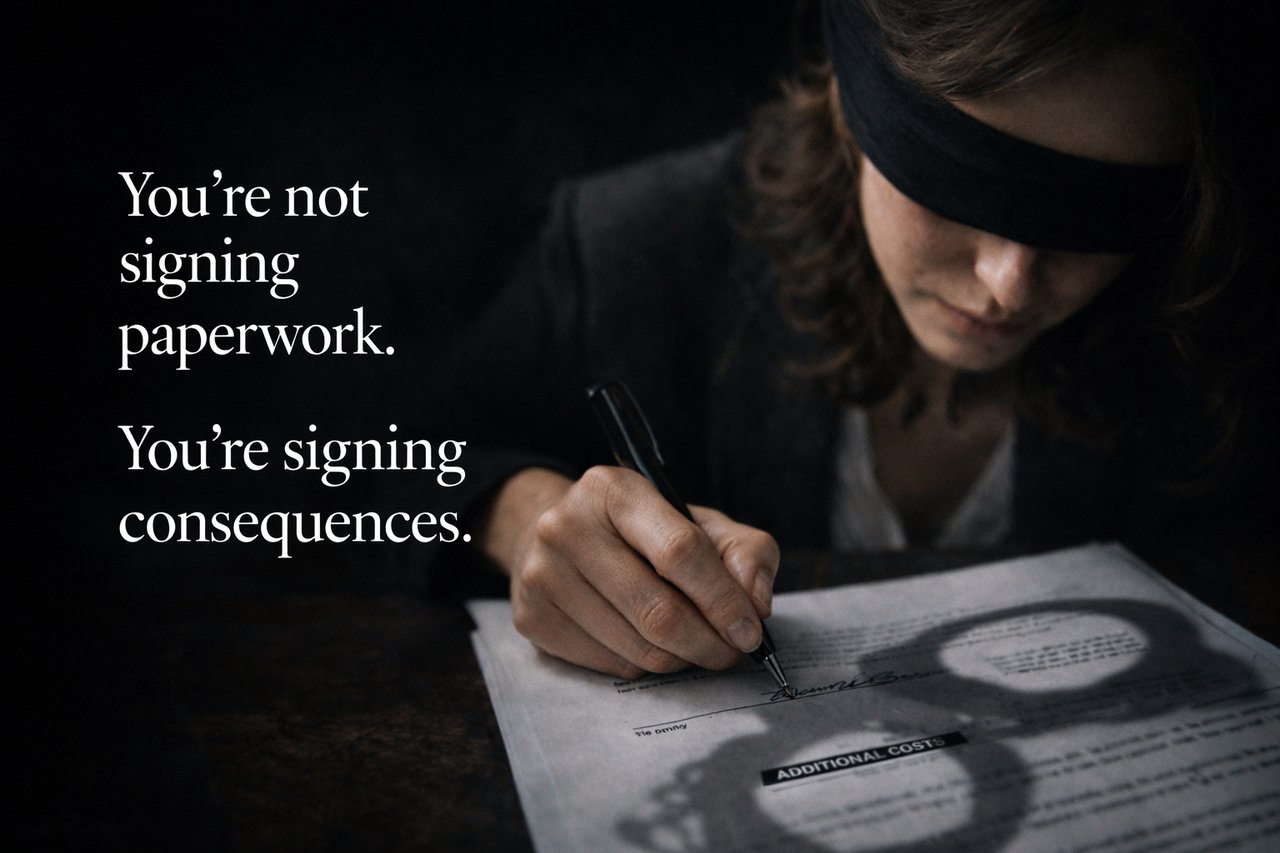
A contract is not paperwork. It is a map of consequences. Every page is answering the same underlying question: If something goes wrong, who pays? Not in theory. In writing.
And when you sign without understanding that, you’re not making the process more efficient—you’re agreeing to outcomes you haven’t fully examined.
I saw it happen in real time
Recently, I was sent a contract outlining what my costs were expected to be. It seemed clear enough, straightforward, consistent with what had been discussed. I signed the initial portion. The following day, the remaining pages arrived. Within those additional sections was a clause that materially changed the picture—effectively increasing my exposure by another 20 percent.
It was the same deal.
But it was not the same understanding. Had I signed everything the moment it appeared in my inbox, I might have caught it later. Or I might not have. And even if I had, I would have been left trying to unwind something I never intended to agree to in the first place.
That’s the part people underestimate.
Not whether you can get out of a contract.
But what it costs—in time, leverage, and stress—when you have to.
Here’s where people get it wrong
It’s easy to assume that the responsibility sits with someone else. With the person who prepared the document. With the agent guiding the process. With the system that delivered it. And to some extent, that assumption is understandable. Real estate transactions are structured to feel guided, almost managed, as if the important parts have already been accounted for by someone with more expertise.
But that’s not where responsibility ultimately lives.
No one is more accountable for what you sign than you are—not because you are expected to interpret legal language at a professional level, but because you are the one assuming the consequences of the agreement. A contract doesn’t adjust itself to your level of understanding. It doesn’t soften based on what you intended or what you thought you were agreeing to.
It holds.
And it holds based on one thing: your signature.
The problem is getting worse
If anything, the environment around this has only made the problem more pronounced.
Technology has removed the friction that once forced people to slow down and engage more directly with what they were signing. There was a time when contracts were reviewed in person, page by page, in a setting that naturally created pauses—moments where questions could be asked and clarified before anything was finalized.
I used to sit with clients and walk through documents line by line. We would stop, revisit sections, and make sure the structure of the agreement was understood before moving forward. It wasn’t efficient in the modern sense, but it created clarity.
That moment has largely disappeared. Now contracts arrive in your inbox, often in stages, and signatures can be completed in minutes. What used to be a conversation has been compressed into a sequence of clicks. And with that shift, something important has been lost. The ease of signing has outpaced the effort required to understand.
So the process moves faster—but the comprehension doesn’t.
And that gap is where most of the risk now lives.
A better standard
You don’t need to read like a lawyer. But you do need to understand like an owner. That begins with a simple expectation: you should be able to explain, in plain language, what you are agreeing to and where your risk sits.
Your agent should be able to give you a clear, concise overview of the contract—what it is, what it does, and where the exposure lies. But it shouldn’t stop there. You should also be able to walk through the document, page by page, and understand how each section affects you.
Not summaries. Not reassurances.
Clarity.
It’s also important to recognize that the first page is not the deal. Price, dates, and names may be front and center, but the actual structure of the transaction lives in the pages behind it. That’s where contingencies are defined, timelines are enforced, and outcomes are determined if something doesn’t go as planned.
And ultimately, the standard is this: if you can’t explain it, you shouldn’t be signing it.
You don’t need perfect understanding. But you need enough to answer three basic questions: What am I committing to? What could go wrong? And what happens if it does?
If you can’t answer those, you’re not making a fully informed decision.
You’re just moving forward.
Final thought
People don’t lose money in real estate because they signed too slowly. They lose money because they signed too casually. Speed feels productive. It feels like progress. But contracts are not where speed pays off. They are where clarity does.
And no amount of trust, convenience, or efficiency changes one thing:
The moment you sign, the agreement AND the risk stop being theoretical. It becomes yours.
If you’re about to sign something—or just did—take a step back.
I put together a short diagnostic to help you see how exposed you actually are before you commit. Message me “UNDERSTAND” and I’ll send it.
AND: If anything feels unclear as you go through it, that’s usually where the real questions are.