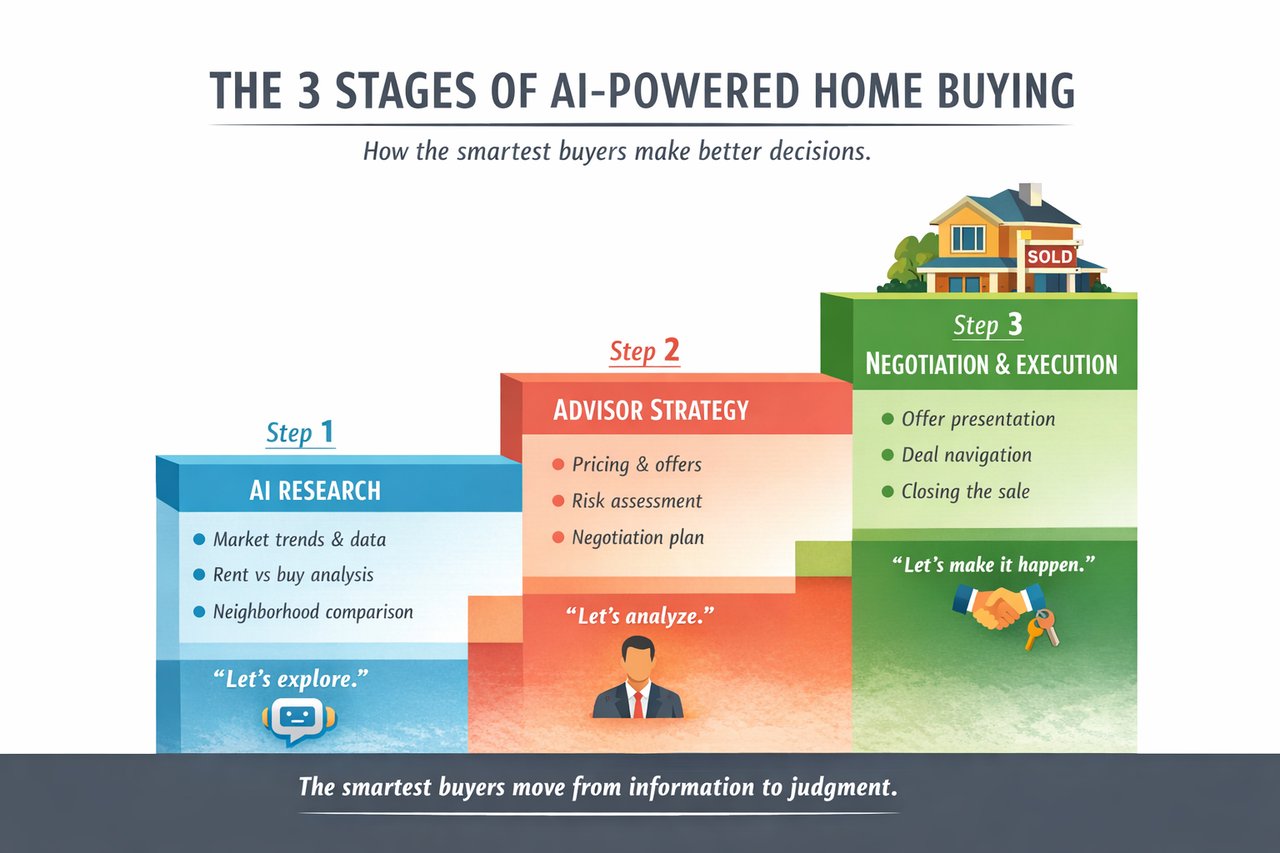
Artificial intelligence has quietly dismantled one of the real estate industry’s oldest advantages: controlling access to information. For decades, buyers and sellers relied on professionals to answer questions about market trends, comparable sales, mortgage payments, and neighborhood dynamics. Much of that knowledge lived inside industry databases and professional experience. Today, anyone can ask AI those same questions and receive an answer in seconds.
Some agents see this as a threat.
I see it as progress.
Because while artificial intelligence has become extraordinarily good at organizing information, real estate decisions rarely depend on information alone. They depend on judgment.
And judgment is rarely found in a dataset.
The End of Information Gatekeeping
Artificial intelligence is making some real estate professionals uncomfortable. Not because it’s wrong. But because it exposes something that used to be hidden. For a long time, much of the perceived value in real estate came from controlling access to information. Agents had it. Buyers didn’t.
Artificial intelligence erased that imbalance almost overnight. Today anyone can ask questions that once required an insider:
- Which neighborhoods are appreciating fastest?
- What does a $1.4M mortgage payment look like?
- How do rents compare to ownership costs?
And the answers appear instantly.
Artificial intelligence didn’t eliminate the value of real estate expertise. It eliminated the value of information gatekeeping. If you’ve already asked an AI tool questions about real estate before speaking with an agent, you’re not alone. Increasingly, buyers and sellers arrive having explored mortgage scenarios, compared neighborhoods, or tested financial assumptions on their own.
What’s interesting is that this doesn’t replace professional conversations. In many cases, it actually makes them far more productive.
A Broader Shift in Decision-Making
What is happening in real estate is part of a much larger shift. For most of modern history, expertise was closely tied to access to knowledge. Lawyers, doctors, financial advisors, and real estate professionals all occupied a similar role: they held information the public did not. The internet began to erode that advantage.
Artificial intelligence accelerates the process dramatically. Information is now not only available — it is organized, summarized, and explained on demand. The result is a subtle but profound change in how people approach decisions. Instead of asking professionals for information, people increasingly arrive having already researched the landscape.
What they seek next is something different. Not answers.
Interpretation.
And interpretation is where experience begins to matter.
Where Artificial Intelligence Excels
Artificial intelligence is incredibly useful during the research phase of buying or selling property.
It’s a powerful way to understand the landscape before making decisions.
Here are ten questions AI handles particularly well:
- What neighborhoods in Miami have appreciated the most over the past 10–20 years?
- What are the advantages and disadvantages of buying a condo versus a house in Miami?
- What would the monthly payment be on a $1.3M home with 25% down?
- What rent would a property need to generate to break even?
- Which Miami neighborhoods are considered walkable?
- What factors tend to drive long-term property value growth in coastal cities?
- How does renting compare to buying over a 7–10 year period?
- What are typical condo association fees in different Miami neighborhoods?
- What insurance challenges affect coastal real estate markets?
- What are the typical costs of owning property in Florida?
These questions are informational. Artificial intelligence is extremely good at synthesizing publicly available knowledge and presenting it clearly. Used well, it allows buyers and sellers to arrive at the process far more informed than they once were. But eventually, every transaction moves beyond information. And that’s where AI begins to struggle.
Where Artificial Intelligence Struggles
Real estate decisions eventually cross into territory where the wrong answer can cost real money. These questions require context, experience, and interpretation.
For example:
- Is this specific property overpriced?
- How much should I offer for this home?
- Why has this listing been sitting on the market?
- How motivated is the seller likely to be?
- Is this condo association financially healthy?
- Is this building likely to face special assessments?
- What negotiation strategy should I use?
- Is this neighborhood improving or declining right now?
- Is this property actually a good investment?
- Should I walk away from this deal?
Artificial intelligence can analyze information. But it cannot interpret human behavior, incomplete signals, and local nuance in real time. Those are judgment calls.
And in real estate, judgment can easily translate into six-figure differences in outcome.
The New Role of the Advisor
The role of the real estate professional has changed dramatically. In the past, the industry revolved around access to data. Today the real value lies in interpreting what the data actually means. In fact, one of the more interesting shifts I’ve noticed is that many buyers and sellers now arrive having already done a significant amount of research with AI. They often walk into our first conversation having explored mortgage scenarios, compared neighborhoods, or tested the financial implications of renting versus buying.
In many cases, that preparation actually makes my job easier. They’ve already begun thinking through some of the same issues I would normally raise at the beginning of the process. That kind of self-discovery can be extremely useful. It allows people to articulate what they value, what concerns them, and what trade-offs they are willing to consider. And the more clearly someone can describe those priorities, the more productive the conversation becomes.
Instead of starting with basic information, we can move directly into the more complicated issues — context, timing, negotiation strategy, and risk.
A seasoned advisor can recognize signals that rarely appear in algorithms:
- When a listing price is strategic rather than realistic.
- When a seller is likely to negotiate — or dig in.
- When competing offers are quietly forming.
- When a building’s financial structure signals future assessments.
- When patience creates leverage in negotiation.
These insights rarely show up in datasets. They come from experience operating inside the market.
Using AI More Thoughtfully
Knowing what to ask AI is useful. Knowing how to ask it well is even better.
When researching real estate, prompts like these tend to produce far more meaningful insight:
- Compare Coconut Grove, Coral Gables, and Brickell in terms of lifestyle, walkability, property types, and long-term price trends.
- Based on someone who enjoys restaurants, cafés, and walkable neighborhoods but prefers quieter residential streets, what Miami areas might fit that lifestyle?
- What are the typical ongoing costs of owning a $1.5M property in Miami, including taxes, insurance, maintenance, and association fees?
- Create a 10-year rent vs buy comparison for a $1.3M property in Miami assuming 25% down and moderate appreciation.
- What structural factors influence property value growth in coastal cities like Miami?
These prompts won’t replace professional advice. But they will help you arrive at the conversation far better prepared.
A Thoughtful Way to Use AI
Artificial intelligence is quickly becoming a powerful research partner for people exploring real estate decisions. But like any powerful tool, it works best when you understand which questions it handles well — and where its limits begin. Over time, I’ve started noticing patterns in the kinds of questions people ask AI before making property decisions. Some questions lead to extremely useful insights. Others can create a false sense of certainty.
Because of that, I’ve put together a short exercise that helps people evaluate how they’re using AI while researching real estate — and whether the questions they’re asking are actually the kinds AI can answer well.
If you're curious about it, feel free to send me a message with the word "AI" and I’ll share it with you.
Many people find the results surprisingly helpful.
The Smartest Buyers Use Both
The most effective approach today isn’t choosing between artificial intelligence and a professional advisor. It’s using both. Artificial intelligence is an extraordinary research partner. It helps people understand the landscape and test ideas. But eventually every meaningful decision moves beyond research.
That’s when judgment matters.
Because when information becomes free, the only thing left to charge for is judgment. And in real estate, good judgment can easily mean the difference between an acceptable outcome and an exceptional one.