When most people look for an investment property, they look for signs of wealth. Luxury buildings. New restaurants. Walkable districts. Expensive coffee shops. The assumption is simple: if affluent people are moving in, property values must rise.
Sometimes that's true. The problem is that by the time everyone notices affluent people moving into a neighborhood, prices have usually adjusted. The easier money has often already been made. Wealth is a lagging indicator. It tells you where opportunity was. It rarely tells you where opportunity is.
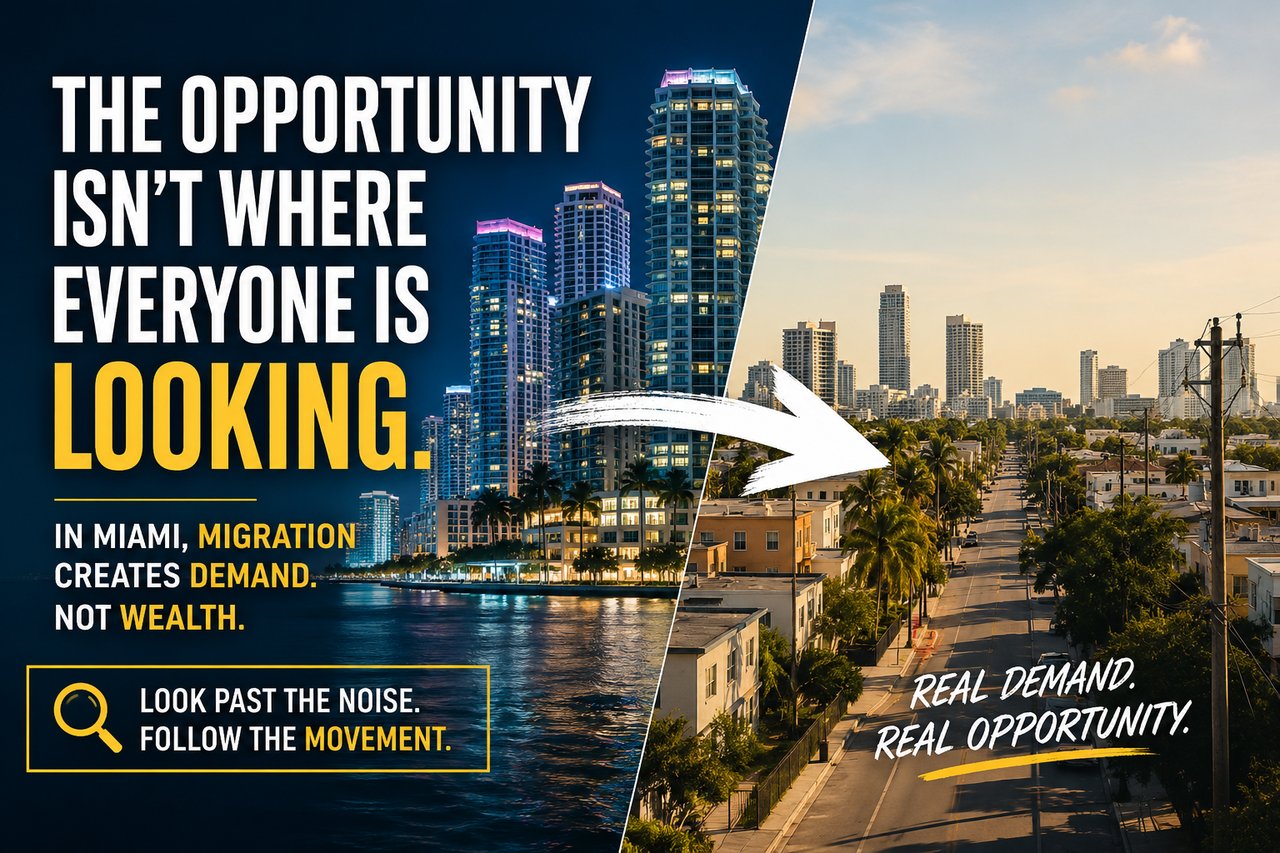
What investors should be watching isn't where wealthy people are going. They should be watching where everyone else is going. Because when a city becomes more expensive, people don't disappear. They relocate. They compromise. They search for alternatives. That migration creates demand. And demand is what ultimately drives real estate.
Wealth creates headlines. Constraints create demand.
Investors chase luxury not because they're wrong but because luxury feels validated. It looks proven. It looks like someone else has already done the hard work of confirming the opportunity. The irony is that by the time luxury feels safest, much of the opportunity has already passed. Safety and timing are not the same thing.
The people who create durable housing demand don't have options. They need to live near work. They need access to schools. They need reasonable commuting distances. They need housing they can actually afford. Those constraints make their behavior far more predictable. And predictable demand is often far more valuable than fashionable demand.
Wealthy newcomers can catalyze a neighborhood. Working families sustain one. Those are different forces, and confusing them is one of the most common mistakes investors make in a market like Miami.
Miami investors love growth stories. Most tenants are living budget stories.
Miami has a particular version of this problem. The conversation here is dominated by appreciation narratives. The next Wynwood. The next Brickell. The next neighborhood that's going to explode. Investors arrive looking for the growth story and end up paying for it before it's proven.
Meanwhile, most of the actual housing demand in Miami is being generated by people trying to solve a math problem. They need to live somewhere they can afford, near work they can get to, in a neighborhood stable enough to raise a family or build a life. They are not chasing a story. They are chasing a solution.
Cheap is not the same as investable
A low price can be a sign of opportunity. It can also be a warning. The neighborhoods where prices stay low indefinitely usually have a reason — high turnover, management headaches, insurance challenges, limited appreciation. The spreadsheet looks attractive. The reality is a second job. The goal isn't to buy the cheapest property available. It's to buy in places where people genuinely want to live and where demand has room to grow.
The difference between displacement and demand
There's a difference between housing people choose because it fits their budget and housing people tolerate because they have no other option. One creates durable demand. The other often creates headaches. Understanding that difference may be one of the most important skills an investor can develop.
Migration alone isn't enough. The migration has to be sustainable — employment-supported, tied to real infrastructure, rooted in places people are choosing to live, not merely being forced to leave. The neighborhoods worth paying attention to are the ones absorbing people who are moving toward something: a shorter commute, a manageable mortgage, a neighborhood with schools and services and a reason to stay.
What demand looks like in Miami right now
Housing near major employment centers is becoming more valuable because affordability elsewhere keeps disappearing. The people who work at Jackson, the airport, and the Health District still need somewhere to live. That's a location thesis, not a neighborhood recommendation.
Where entry costs remain below those of immediately surrounding markets, relative affordability creates a broad and resilient tenant pool. The risk there isn't the neighborhood. It's the building. In today's condo market, reserves, assessments, and insurance exposure are the investment. The unit is secondary.
Further south, families who have run the numbers and concluded that affordability outweighs proximity are creating demand that doesn't depend on appreciation to make sense. That's an arithmetic thesis, not a discovery story.
Bottom line
Most investors lose not because they pick the wrong neighborhood but because they trust the wrong signals. Attention feels like demand. Appreciation stories feel like fundamentals. Luxury feels like safety. None of those things are the same.
The investors who consistently outperform aren't smarter. They're asking better questions. Not where is wealth going — but where are people being pushed, and is that place worth choosing? Not what's getting attention — but what's generating need?
The opportunity isn't poverty. It's migration.
In a city as loud as Miami, the signal worth trusting is usually the quietest one in the room.
Serious about Miami real estate? Let's talk.
Sara Mullis · Real Estate Advisor, Compass · 305.781.4320