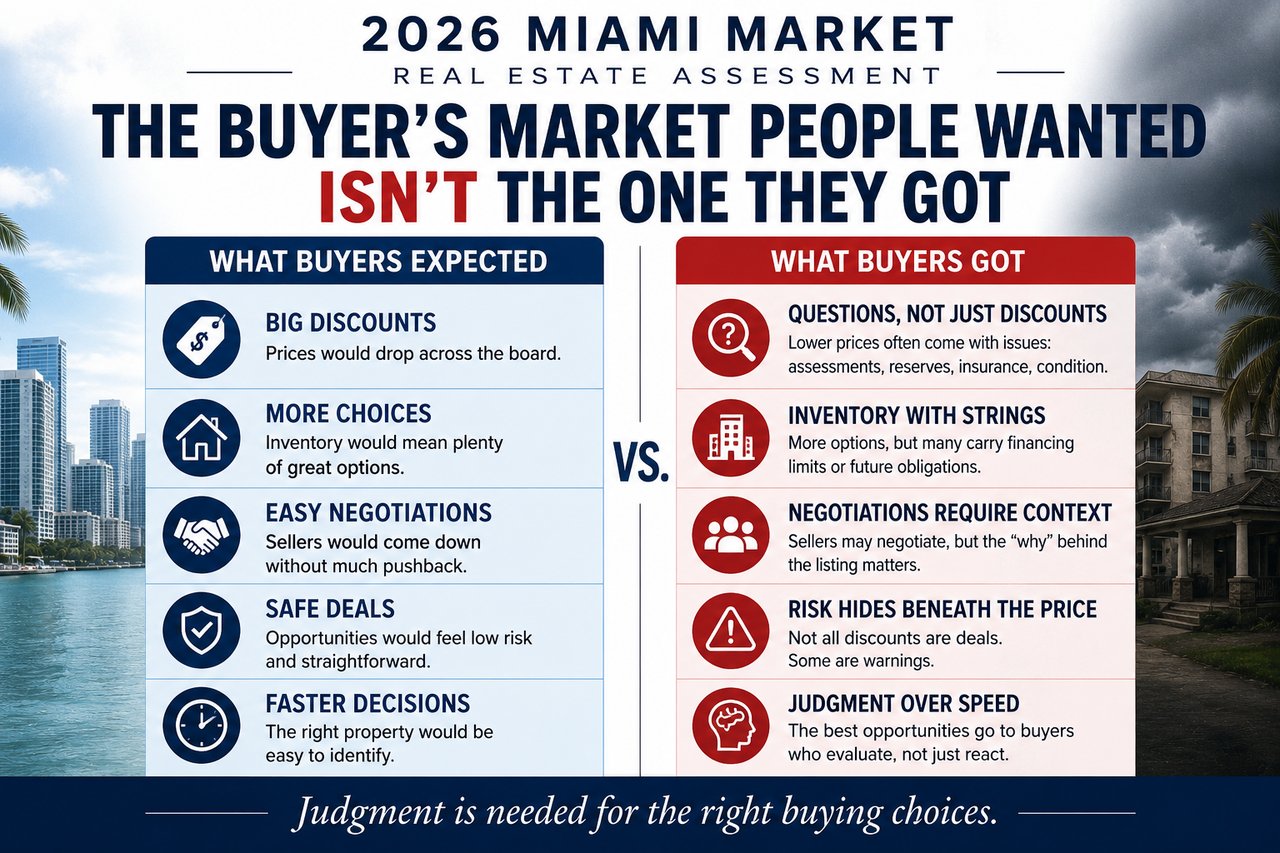
The Buyer's Market Everyone Imagined
For years, buyers told themselves the same story. When the market cools down, I'll have options. When inventory increases, I'll have negotiating power. When sellers become realistic, I'll finally get a deal.
There was nothing irrational about that thinking. During the frenzy years, buyers were competing against dozens of offers, waiving contingencies, and watching prices climb faster than their incomes. They weren't waiting for perfection. They were waiting for leverage. And as we reach the midpoint of 2026, that leverage has arrived. The question nobody quite prepared for is what it's attached to.
Across Miami-Dade, buyers have more choices than they've had in years. Inventory has expanded significantly from the conditions that defined 2021 and 2022, properties are taking longer to sell, and negotiation has returned to the process. In many segments, sellers are making concessions that would have been almost unthinkable a few years ago. The numbers tell the story: in April, Miami-Dade condominium inventory reached 12.9 months of supply, and by most industry standards anything above six to nine months is a buyer's market. Single-family homes remain tighter at roughly 5.4 months, but even there buyers are seeing a level of choice that has been absent for years.
Buyers spent years asking for leverage. The market delivered. It simply didn't deliver it in the form many people expected.
Leverage Always Comes From Somewhere
Markets do not hand out discounts randomly. Every meaningful price reduction, every seller concession, every property sitting well past its original list date has a cause. Sometimes it's a seller who needs to move. Sometimes it's a building carrying obligations the market has started to price in. Sometimes it's an insurance environment that has made the true cost of ownership higher than the purchase price suggests. None of that means the opportunity isn't real. It means the opportunity isn't free.
Leverage in a complex market is not the same as leverage in a simple market. In a simple market, negotiating power mostly means you pay less for the same thing. In this one, it often means you're being offered the chance to take on something the previous buyer walked away from. That's a different proposition, and it requires a different kind of thinking.
None of this is happening in a vacuum. Miami-Dade condominiums are currently receiving roughly 93 percent of original list price. Days on market have stretched, seller fatigue is increasingly visible, and price reductions have become part of the normal process rather than a sign of distress. Buyers spent years saying they wanted leverage. What many actually wanted was safety at a discount. Those are not the same thing, and the market in mid-2026 is making that distinction impossible to avoid.
The Condos Are the Evidence, Not the Story
The clearest illustration of this dynamic is playing out in Miami-Dade's older condominium inventory. Reserve funding requirements, milestone inspections, special assessments, insurance pressures, financing constraints — none of these issues appeared overnight. Most have been developing for years. What has changed is the market's willingness to ignore them.
Units that once generated bidding wars now sit on the market while buyers perform actual due diligence. Financing has become more selective: among the thousands of condominium buildings across the region, fewer than one percent currently hold FHA approval. That matters — not because FHA buyers are the entire market, but because financing restrictions shrink the buyer pool, and a smaller buyer pool changes pricing power.
The negotiating leverage buyers imagined is sitting right there in these listings. The problem is that it comes attached to questions: about reserves, about assessments, about future maintenance, about financing, about insurance. The condos are not the point. The condos are the example. The same logic applies to a single-family property with deferred maintenance, to neighborhoods absorbing rising insurance costs, to any situation where the market is offering a discount and the buyer's job is to understand why. The segment changes. The underlying question doesn't.
The Single-Family Market Is Telling a Different Story
If condominiums are showing buyers what leverage looks like, the single-family market is showing them its limits. Inventory has increased compared to the ultra-tight pandemic years, inspection contingencies have returned, sellers are making repairs again, and price reductions are no longer rare. Yet many buyers who spent years waiting for a buyer's market are discovering that the properties they actually want remain surprisingly resilient.
The well-located house in a desirable school district. The property that has been properly maintained. The home that doesn't carry obvious insurance, condition, or deferred maintenance concerns. Those properties are still attracting attention — not because the market hasn't changed, but because buyers continue to value certainty.
This is one of the most misunderstood aspects of the current market. People hear that inventory is up and assume every property should become dramatically cheaper. Markets don't work that way. Inventory expands unevenly, demand weakens unevenly, and buyers become selective long before they disappear. As a result, the properties experiencing the greatest pricing pressure are not necessarily the most desirable ones. They're the ones carrying questions the market is struggling to answer.
There is a name for what today's buyers are actually shopping for, and it isn't square footage. It's the absence of work. The fixer-upper — once the entry point for buyers priced out of finished homes — has lost its audience. Buyers in this market do not want projects, they do not want contractors, and they do not want surprises in year one. They want turnkey, and they are paying a visible premium for it while walking past anything that hints at effort. A dated kitchen used to be a negotiating point. Today it can be the reason a showing never happens.
Sellers should hear that clearly, because it changes what "ready for market" means. Deferred maintenance is no longer something the buyer absorbs into the price. It's something the listing absorbs into its days on market. The homes selling well in Miami-Dade right now are not necessarily the biggest or the best located. They are the ones that ask nothing of the buyer.
That distinction matters, because buyers waiting for a broad collapse in pricing are looking at the wrong signal. This market is not rewarding every buyer equally. It is rewarding buyers who can distinguish between a temporary problem, a permanent problem, and a problem that exists only because everyone else is nervous. And here the turnkey obsession circles back on itself: when an entire market refuses to consider anything that looks like work, the few buyers willing to evaluate work honestly inherit the leverage everyone else abandoned.
A Discount Is Not the Same Thing as a Deal
Most people use those terms interchangeably. They shouldn't. A discount means something is cheaper than it was. A deal means the risk-adjusted value is attractive relative to what you're paying. Those are entirely different conclusions. A property can be deeply discounted and still be a poor decision, and a property with no discount at all can be an exceptional one. Price and value are related. They are not the same variable.
A condominium facing a large unresolved special assessment may be priced dramatically below its 2022 peak. That discount is real. Whether it represents value depends on what the assessment costs, what it fixes, what it means for future ownership, and what the building looks like on the other side of the process. The market has done the discounting. It has not done the analysis. That part belongs to the buyer.
There is also the inverse, which receives far less attention. A building everyone is avoiding because the situation looks complicated may represent genuine value precisely because the crowd has left. The discount in that scenario is being created by discomfort rather than defect, and those are very different things. The market doesn't tell you which situation you're looking at. It merely creates the opportunity. You still have to do the thinking.
The Question Has Changed
For most of the last few years, the central question in Miami real estate was simple: can I win the property? Buyers organized themselves around speed, and the skill that mattered was decisiveness. Today the question is different. Can I evaluate the property? That requires something else entirely.
It means understanding what a pending assessment does to a balance sheet. It means knowing which buildings have completed their milestone inspections and which have not. It means stress-testing carrying costs before an offer is written, and understanding the difference between a problem that has been solved and a problem that has merely been postponed. Urgency is occasionally still required. Judgment is required every time. The market is no longer rewarding the fastest buyer. It is rewarding the most prepared one.
The Mid-Year Reality Check
The biggest story in Miami-Dade real estate at mid-2026 is not that buyers finally gained leverage. It is that leverage arrived faster than confidence. Inventory has expanded, negotiating power has returned, condominiums have moved firmly into buyer's market territory, and single-family homes have become more negotiable without becoming less desirable. The result is a market that looks easier from a distance than it does up close.
This is not a collapse story. Total sales in Miami-Dade have actually increased compared to a year ago. Buyers are still buying, sellers are still selling, and transactions are still happening. What has changed is the nature of the decision. Buyers spent years imagining a market where the answers would become easier. Instead, they got a market where the questions became more important.
That is a harder version of the opportunity they were waiting for. It is also a more honest one. The buyer's market did arrive. It just didn't arrive as a clearance sale. It arrived as a test of judgment.
Five Things to Watch in Today's Miami "Buyer's Market"
- The reason behind the price cut. Every discount has a cause — a motivated seller, a building obligation, an insurance reality. Until you know which one you're looking at, you don't know what you're negotiating for.
- The building's paperwork, not its lobby. Reserve funding, milestone inspection status, assessment history. The difference between a problem that's been solved and one that's been postponed is the difference between a deal and a liability.
- The full cost of owning, not the cost of buying. Insurance, assessments, and maintenance can turn an attractive purchase price into an unattractive monthly reality. Stress-test the carrying costs before the offer, not after the closing.
- The certainty premium. Well-maintained, well-located homes are not getting cheaper the way the headlines suggest. If you're waiting for a discount on a turnkey property in a strong neighborhood, you may be waiting for a market that isn't coming.
- What the crowd is avoiding — and why. Some properties are discounted because of defects. Others are discounted because of discomfort. The buyers who can tell those apart are the ones this market is actually rewarding.
None of these five require a prediction about where the market goes next. They require something rarer: the discipline to evaluate what's in front of you while everyone else is reacting to it. The buyers who waited years for this market deserve to be told the truth about it — the opportunity is real, the leverage is real, and neither one will do the thinking for you. The market has finally agreed to negotiate. What you bring to the table is judgment.
Serious about Miami real estate? Let's talk.