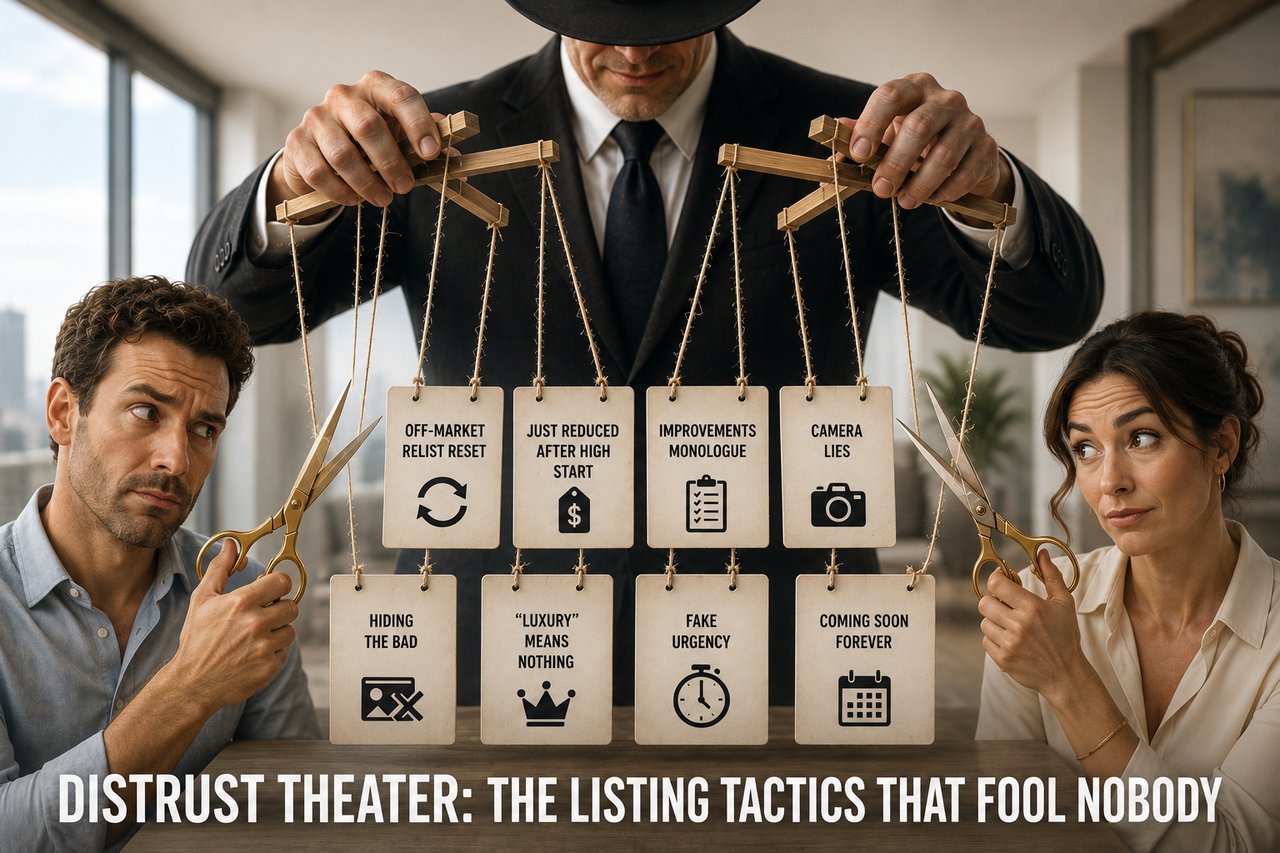
The market has become so obsessed with gaming perception that many listings now feel less trustworthy the more effort goes into manufacturing urgency. Buyers feel it immediately — even when they can't name it.
There is a difference between marketing a property and performing a property. Good marketing is honest persuasion — it finds the best true version of what you're selling and puts it in front of the right people. Performance is something else. It's theater. And the problem with theater, especially in a market where buyers have MLS history, Zillow alerts, price trackers, and saved searches, is that the audience already read the script.
The list of tactics below aren't annoying because they're aggressive. They're damaging because they signal inauthenticity before a buyer ever sets foot in the door. They communicate, often loudly, that something is being managed around rather than sold. And once that suspicion lands, everything else — the pricing, the showings, the negotiation — gets harder. This isn't a campaign against smart strategy. It's a campaign against fake strategy. There's a difference.
The market rewards confidence, but it punishes credibility gaps. And today's buyers are far better at spotting them than the industry wants to admit.
THE 'KILL' LIST
NO. 1
The Off-Market / Relist Reset-
Taking a listing down only to relist it the next morning — sometimes within hours — doesn't reset the clock. It resets nothing. What it does is trigger every buyer who had that property saved with a quiet, immediate question: what happened?
The relist itself isn't the problem. The transparency vacuum is. Buyers can see the corpse with fresh makeup on. They have the DOM history. They remember the original price. They got the alert. And when a price reduction accompanies the relist, the instinct isn't "opportunity." It's "desperation." Especially in Miami, where people track listings with an almost competitive obsessiveness.
This move was designed for an era when information moved slowly. That era ended.
NO. 2
"Just Reduced" After Starting Delusionally High-
A $4.5M listing dropping to $4.1M after 28 days is not a market event if the property was worth $3.7M from the beginning. Everyone remembers the original number. The reduction doesn't reset positioning — it confirms the concern.
Psychologically, massive early reductions often weaken a listing's standing rather than strengthen it. They tell buyers that the seller overreached, that the traffic was bad, that more cuts may be coming — which means the rational move is to wait. The fake-reduction strategy worked a decade ago. Today it mostly generates patient buyers and eroding leverage.
NO. 3
The "We Spent $700,000 on Improvements" Monologue-
Nobody cares what you spent. This deserves to be said plainly. Buyers care whether the house feels worth the ask, whether the upgrades match today's taste, whether the work was done well, and whether they'll have to redo half of it anyway. The market does not reimburse emotional attachment to a renovation.
A fourteen-page improvement spreadsheet communicates one thing clearly: please validate our financial decisions. Half the time those decisions involved outdated marble, over-customization that narrows the buyer pool, niche luxury choices others won't pay for, or tech that already needs replacing. Cost basis is not market value. They have never been the same thing. The improvement list belongs after a buyer is already interested — not before they've decided whether to be.
NO. 4
The Camera Lies. And Everyone Knows It.
Wide-angle lens abuse is now so endemic that buyers simply assume listed rooms are smaller than photographed. Which means the tactic has not only stopped working — it's become a baseline negative. A tax on your listing's credibility that you pay on every showing, the moment someone walks in and thinks: wait, this is the living room?
But the wide-angle lens is just the entry-level version of this problem. The advanced class is the strategic ocean-angle photo — one carefully composed shot of water that doesn't change the reality that you stare into another tower from the living room, the highway is audible on the terrace, and the "water view" requires leaning off the balcony at a specific angle while standing on something.
People now cross-reference listings with Google Earth before they tour. They pull up satellite view. They check street level. The internet killed fantasy positioning at the very first step of a buyer's search. A strategic photo that doesn't survive a three-minute map search isn't positioning — it's a liability that starts every showing with a defensive conversation.
NO. 5
The Information They Decided You Didn't Need-
There's a version of this that's just bad photography strategy — skipping the second bathroom, hiding the low ceiling, never showing the view from the actual balcony angle you'd use every day. That's annoying. But the deeper problem is what it represents. Many listings are built around a deliberate calculation: give buyers enough to get them through the door, and handle the rest in person. The thinking is that once someone is standing in the space, momentum takes over. Proximity closes.
What actually happens is the opposite. Buyers who arrive having been managed — who walk in and immediately start finding things that weren't in the listing — don't feel surprised. They feel deceived. And that feeling poisons everything that follows: the showing, the negotiation, the relationship with the agent, the trust in the ask price.
Modern buyers don't want to be brought in. They want to self-select in. The listings that earn the most genuine interest are the ones that give buyers everything upfront — including the difficult stuff — and let them decide. That kind of transparency doesn't scare off buyers. It attracts the right ones.
NO. 6
The Word "Luxury" Meaning Absolutely Nothing-
Miami is addicted to this. Everything is luxury. Everything is resort-style, exclusive, curated, sophisticated, designer. Meanwhile: builder-grade cabinets, seven-foot ceilings, a noisy road out front, an awkward layout, no privacy from the building next door, and finishes that were aspirational in 2009.
Inflated language doesn't elevate a listing. It establishes a gap between expectation and experience that the property then has to close — and usually can't. Luxury is experienced. It is not declared in a listing description. Every adjective that doesn't hold up on arrival is a withdrawal from a trust account that was already low.
NO. 7
Manufacturing Urgency-
"Multiple offers expected." "Won't last." "Best and final by tomorrow." On a listing sitting for 97 days. Sophisticated buyers — and most buyers in this market are now sophisticated — don't accelerate under artificial pressure when no actual demand is visible. They slow down. They wonder what the seller knows that they don't. And they walk away from listings that feel like a pressure campaign rather than a confident ask. Urgency borrowed against nonexistent scarcity isn't urgency. It's noise. And buyers have learned to tune it out entirely.
Fake urgency on a live listing is one thing. But the coming-soon play manufactures mystique before there's anything to be mysterious about — which is a different kind of problem. A listing teased indefinitely without launching starts feeling problematic before it ever hits the market. What was meant to build anticipation builds suspicion instead. Luxury sellers especially love this move, believing it signals scarcity and exclusivity. Mostly it signals indecision, which is a harder thing to recover from than simply launching well. When the property finally does list, buyers arrive with lowered expectations and a running hypothesis about why it was never ready.
Aspirational pricing, for all its problems, at least comes from optimism. These tactics come from something else — a belief that buyers can be managed, that perception can be engineered, that the gap between what a property is and what it appears to be can be held open long enough to close a deal. It rarely can. And the cost of trying is almost always paid in trust.
The listings that sell well in this market share one thing: they don't need any of the above. Confidence is a strategy. It just requires pricing that supports it.
A STRAIGHT CONVERSATION-
If any of this resonates — whether you're actively listed, thinking about listing, or just trying to understand why something isn't working — I'm happy to talk it through honestly. No pitch, no agenda. What you do with it is entirely up to you.