Size is a number. Spatial dynamics are the experience.
And yet, most buyers are trained to focus on the number. Square footage dominates listings. Developers market it aggressively. Price per square foot becomes shorthand for value. Bigger sounds better. Larger feels safer.
But here’s the thing:
No one actually lives inside a statistic.
- They live inside how a home moves.
- How it connects.
- How it feels on a Tuesday morning and on a Saturday night with friends over.
- That’s spatial dynamics.
It’s the difference between walking through a property and sensing constant interruption… or moving through it effortlessly.
I recently walked two homes.
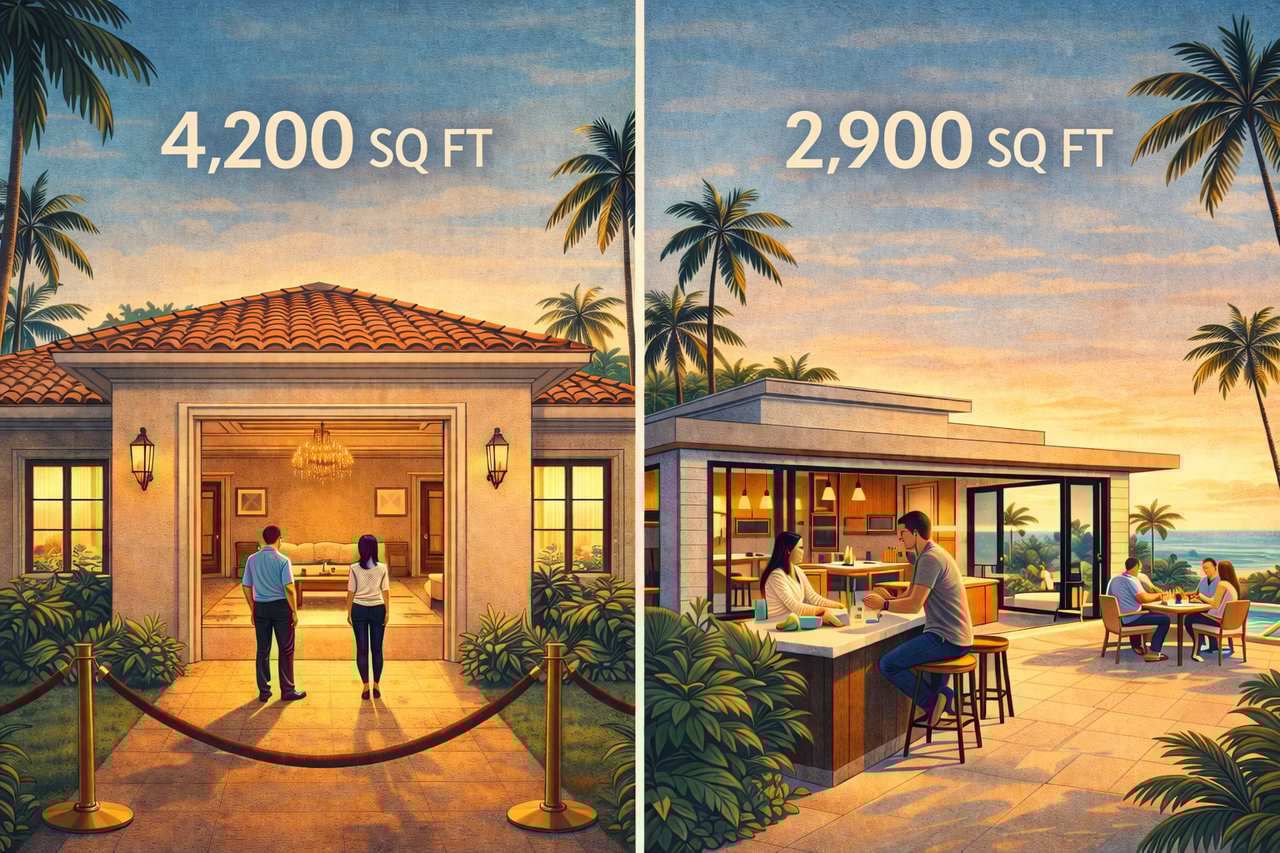
The first was 4,200 square feet.
Grand ceilings. Formal rooms. Beautiful finishes. On paper, it checked every box.
But within minutes, something felt off.
The kitchen was visually isolated from the main living area. Circulation forced you around furniture instead of guiding you naturally forward. The primary suite sat at the end of a long, narrow corridor that felt more like a hotel wing than part of a home. There was space. But. There was no cohesion.
A week later, we toured a 2,900 square foot home.
Smaller. Less dramatic on paper.
But the kitchen opened naturally into the living space. Sightlines extended toward the outdoor terrace. Light traveled from front to back without obstruction. Movement felt intuitive.
It felt larger — not because it was. Because. It worked.
Spatial dynamics isn’t about trends. It’s not simply “open concept” versus traditional layout. It’s about alignment between architecture and lifestyle.
- If you entertain, does the kitchen integrate you into the gathering — or isolate you?
- If you work from home, is there a clear psychological boundary between focus and family life?
- If you have guests over, do people naturally gather — or disperse into disconnected rooms?
Homes with strong spatial dynamics reduce friction. They support daily life instead of interrupting it.
And that has consequences.
They photograph better. They show better They feel larger than their square footage suggests. Buyers linger longer. And. Attach faster. And attachment drives decisions.
The regret I hear most often isn’t: “I wish we had 300 more square feet.”
It’s:
- “We never use that room.”
- “It feels disconnected.”
- “It just never felt quite right.”
That discomfort is rarely about size. It’s about how the space lives. Because square footage is math. But spatial dynamics is psychology.
- It’s how light moves.
- How rooms relate.
- How daily routines flow from one space to another.
It’s how a home supports the life happening inside it.
Before you fall in love with a number, walk the home differently. Stand in the kitchen and look around. Walk from the garage as if carrying groceries. Imagine guests arriving.
Picture a quiet Sunday morning. Ask yourself one question:
Is this home designed for how I actually live?
Because size is a number. Spatial dynamics are the experience.
If you’d like the Spatial Dynamics Evaluation Checklist I use with clients when touring properties, simply reply to this email with “DYNAMICS” and I’ll send it to you.
Once you learn to evaluate homes through this lens, you’ll never walk a property the same way again.