Spend five minutes in real estate media and you’ll hear very confident opinions about what’s about to happen.
- "Rates will drop."
- "Rates will stay higher for longer."
- "Inventory is rising."
- " Inventory is tightening."
- "Buy now. " or. "Wait six months." or. "Wait till next year."
That’s all fine — even useful — if you’re buying a home for yourself. But if you’re allocating capital, six-month predictions don’t move the needle. Wealth in real estate is rarely built on what happens this quarter. It’s built on understanding where a place sits in its evolution. Not guarantees. Not hype. Just pattern recognition.
And while no one has a crystal ball, mine is as good as anyone else’s.
So instead of asking what Miami will look like this year, I’ve been asking a different question:
What will this city look like in ten?
Fifteen years ago, Brickell didn’t look inevitable.
- It looked crowded with cranes.
- It looked overbuilt to some.
- It looked like a bet.
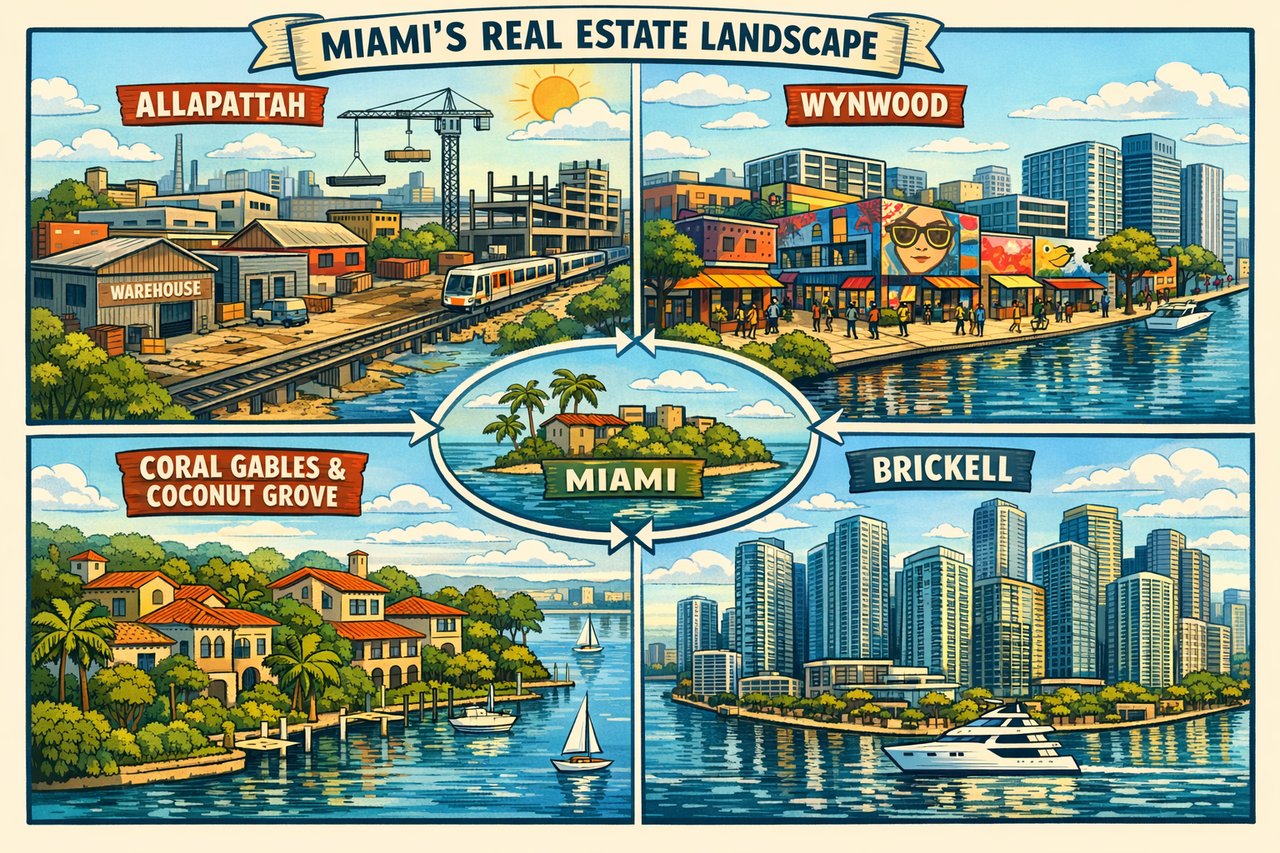
You could feel the momentum, but it wasn’t fully validated yet. Capital was flowing in. Developers were assembling land. Density was rising faster than comfort levels. What was really happening wasn’t oversupply. It was institutionalization. Brickell was crossing the line from speculative growth node to financial core. Today, no one questions it. The skyline is set. Global capital trades there comfortably. Liquidity is deep. It behaves like a mature urban center. The explosive phase is over.
Now it performs.
That arc matters — because you can see different versions of that timeline playing out across Miami right now.
Walk through Wynwood today and you don’t feel discovery. You feel design.
The creative edge is still there, but it’s curated now. Large-scale developers aren’t testing the waters — they’re engineering the future density. Zoning is largely defined. Institutional capital is not dipping a toe; it’s embedded. This is not the “will it work?” chapter.
This is the “how big does it get?” chapter.
There’s still growth ahead. But it’s structured growth. The kind that comes from refinement, scale, and execution rather than raw transformation. Wynwood today feels a lot like Brickell did mid-transition — past the uncertainty, not yet fully matured, but clearly on a defined trajectory. That’s an important place in a cycle. It’s not early. But it’s not finished either.
Drive a few minutes west and the energy changes. Allapatah doesn't feel polished.
It doesn’t feel inevitable. It doesn’t even feel coordinated yet. That’s exactly what makes it interesting. You see industrial buildings beside creative conversions. You see land still being quietly assembled. You hear zoning conversations still unfolding rather than finalized.
It feels… unresolved.
And unresolved neighborhoods are where 10-year bets live. This is the stage Wynwood was in before consensus formed. Before the institutions. Before the headlines.Early positioning never feels comfortable. It rarely feels obvious. The infrastructure lags. The branding isn’t complete. The capital isn’t uniform.
But:
- Basis is lower.
- Optionality is higher.
- Zoning evolution can change the math dramatically.
Allapattah may mature slowly. It may accelerate faster than expected. But it is clearly in a different chapter than Brickell or Wynwood.
And chapters matter. Then, there are the neighborhoods that don’t behave like growth stories at all.
Coral Gables. Coconut Grove.
They don’t need reinvention. They don’t depend on zoning shifts. They don’t rely on density plays. They function as wealth anchors. Supply is constrained. Ownership tends to be longer term. Emotional attachment to these neighborhoods runs deep. When volatility hits, capital doesn’t flee from them — it retreats into them.
You don’t buy there to double quickly.
You buy there because ten years later, through multiple cycles, they’re still standing firm. They protect. They preserve.
They don’t chase.
And then there’s Miami Beach. Which plays by its own rules.
Miami Beach isn’t expanding. It’s not densifying into new corridors. It is geographically fixed — water on both sides. Scarcity is baked in. But even there, the story splits in two.
South Beach is a global luxury brand: Trophy waterfront assets. International capital. Replacement costs that keep climbing. It behaves more like Monaco than Midtown.
North Beach feels different: Older buildings. More redevelopment potential. Lower price per square foot. Infrastructure improving. It sits in transition — not early, not fully mature.
The valuation gap between North and South Beach matters.
Coastal scarcity is powerful. But coastal repricing can be even more powerful.
AND. This is why short-term forecasts feel incomplete to me. Asking whether prices move 3% this year misses the bigger reality: Miami isn’t one market. It’s several markets moving through different stages of maturity at the same time.
- One neighborhood is being institutionalized.
- Another is being engineered.
- Another is being quietly accumulated.
- Others are simply holding wealth steady.
The opportunity over the next decade won’t come from guessing next quarter’s interest rate. It will come from correctly identifying phase. Because ten years from now, one of today’s unresolved districts will feel obvious. One of today’s scaling districts will feel fully institutional. And one of today’s anchors will have quietly done what anchors do — preserved capital while the rest of the cycle moved around it.
This isn’t certainty. It’s perspective.
And if we’re all working with imperfect crystal balls anyway, I’m comfortable placing mine on the long arc of how cities mature.
Ten years is where the real story gets written.
This is a framework, not a promise. My crystal ball is as imperfect as anyone’s — but it’s grounded in cycles, capital flows, and how cities actually evolve.
If you’d like the expanded version with the charts and supporting analysis, let me know, I'm happy to share if you're interested.