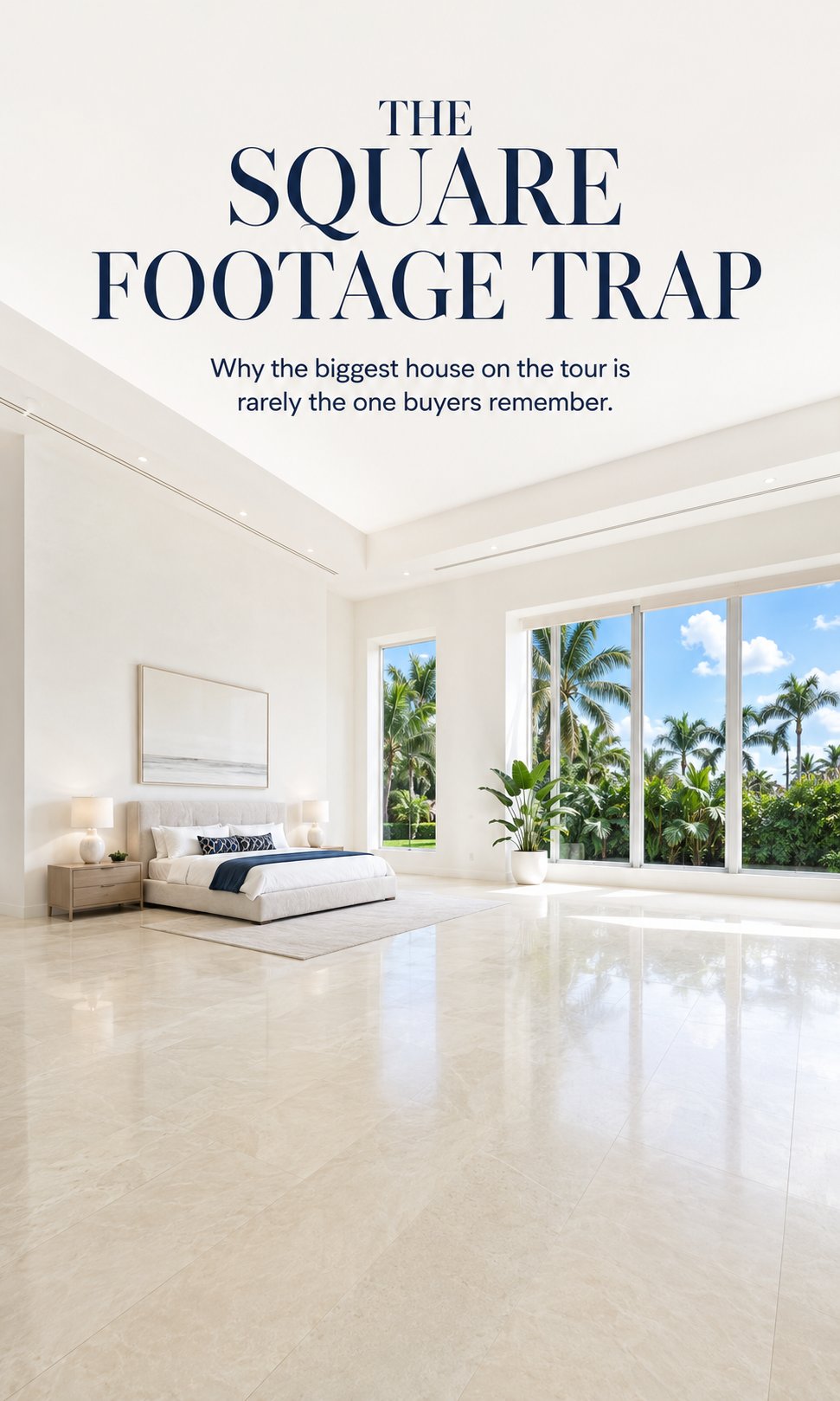
Every listing leads with it. Every buyer filters by it. Every showing eventually circles back to the same question, asked almost reflexively: How many square feet? It's the first number anyone learns about a house and often the only one they remember, which is strange, because it's also one of the least useful numbers for predicting whether anyone will actually be happy living there.
Square footage measures area. It says nothing about whether that area does anything. Houses aren't experienced all at once. They're experienced one habit at a time — every morning, every load of groceries carried in from the car, every trip from the laundry room back to wherever the rest of the house actually lives. None of that shows up in the listing. All of it shows up in the first six months of ownership.
SIZE IS EASY TO MEASURE. LIVABILITY ISN'T.
Square footage fits neatly into an MLS field. Livability requires walking through a house slowly enough to imagine an ordinary day inside it — and most buyers never slow down enough to do that, because they've been trained to ask the wrong question first. I've shown four-thousand-square-foot houses where you lose real time simply walking from the kitchen to wherever everyone else has gathered. I've shown twenty-four-hundred-square-foot houses where nothing feels missing, because nothing was wasted to begin with. The number measures both houses equally well. It doesn't measure which one anyone would rather live in.
THE MOST EXPENSIVE ROOM IS OFTEN THE ONE NO ONE USES.
Buyers pay full price for every square foot. It doesn't matter whether they use it every day or twice a year. They cool it. Clean it. Furnish it. Maintain it. Insure it. A formal living room no one sits in. A foyer sized for a hotel lobby. A dining room that gets used twice a year. None of it contributes meaningfully to the life actually being lived in the house. That's overhead disguised as space. Almost no one asks whether that space is earning its keep until they're the one paying to insure a room they haven't entered since the walkthrough.
A HOUSE SHOULD FIT THE LIFE, NOT THE OTHER WAY AROUND.
The best floor plans quietly remove friction. You don't notice why the kitchen feels comfortable. You simply notice that people stay there instead of drifting off to separate rooms. You don't think about the distance between the garage and the pantry. You simply stop making unnecessary trips. Great design becomes invisible. Bad design reminds you it's there every day, in small enough doses that it takes a year to notice the pattern — the hallway that's just slightly too long, the switch that's never where your hand expects it, the room you avoid without quite knowing why.
MORE ROOMS ISN'T THE SAME AS MORE LIFE.
Extra square footage doesn't distribute itself intelligently. It gets allocated according to what markets well, not what the plan actually needed — a primary suite pushed to the far end of the house, a fifth bedroom added because five sells better than four, an addition bolted onto the back with its own roofline. The buyer's daily life doesn't rearrange itself to make sense of any of it.
A house can also fail on connection rather than layout. Rooms open onto hallways and other rooms instead of onto a porch, a pool deck, or anything worth stepping outside for — and a Miami buyer paying for the climate ends up living in a house that ignores it. None of this shows up as a defect on paper. It shows up as a bedroom nobody sleeps in, a wing nobody walks through — square footage that counted toward the number and never once counted toward the life. Outside, it shows up the same way: a yard nobody uses, bought and maintained without ever being lived in.
MIAMI MAKES THIS ARGUMENT BETTER THAN MOST MARKETS CAN.
After walking hundreds of homes across Coral Gables, Coconut Grove, Pinecrest, Miami Beach, and beyond, I've noticed something that surprises most buyers the first time I say it out loud. They almost never remember the largest house on the tour. They remember the house that felt easy.
Walk through a well-proportioned 1920s Coral Gables house — twenty-three hundred square feet, built before anyone thought to oversize a primary suite for the sake of it. Every room has a job. The proportions were considered. Light reaches the spaces people actually occupy, because someone designed it that way. Ask the question of every room in a house like that — did this square foot earn its keep — and the answer is usually yes.
Now compare it to a newer house nearby, closer to thirty-two hundred square feet on paper — nearly a thousand feet larger, and not obviously better for it. The foyer is oversized because the plan called for drama rather than function. The primary bedroom is large mostly because there was extra square footage that needed somewhere to go, well beyond what the room itself required. Long hallways connect rooms without adding anything to either end of them. The foyer's excess, the bedroom's surplus, the hallways — those are the square feet I question. On the spec sheet, this house wins by a wide margin. Walking through it, the win is a lot less clear — and I've watched buyers feel that gap in real time, usually somewhere around the second hallway, well before they could have articulated why.
I've also toured newer Coconut Grove houses that get this right — disappearing glass walls that fold a covered terrace directly into the living room, so the official square footage never changes but the way the house lives changes completely. The terrace reads as an extension of the living room instead of a separate space tacked onto it, disconnected from how the house is actually lived in. That's the difference between building to a number and designing for a life. Miami has both kinds of houses in abundance, often two blocks apart, which is exactly why this market is such a useful place to make the argument.
THE MLS CAN MEASURE A HOUSE. IT CAN'T MEASURE HOW IT FEELS.
Price per square foot is a real tool, and I don't dismiss it — appraisers need it, builders need it, market analysts build entire models around it. But it's a pricing metric, not a quality one, and buyers who treat it as both end up making decisions a spreadsheet can defend and daily life can't. The house with the lowest price per square foot isn't automatically the better value. And the house with the most square footage isn't either. The best value, more often than not, is the house where nearly every square foot is earning its keep — which is a much harder thing to screen for than a number, and a much more important one.
The next time you're viewing homes, don't ask which one is bigger. Ask which one will make everyday life easier.
The best homes don't have the most square feet.
They have the fewest wasted ones.
Touring homes in Miami? Let's find the house you'll still love on an ordinary Tuesday.